Why Was No Federal Income Tax Withheld From My Paycheck?
A zero on the federal income tax line is not automatically a payroll error. Here are the explanations worth checking, from the withholding tables to an outdated Form W-4.

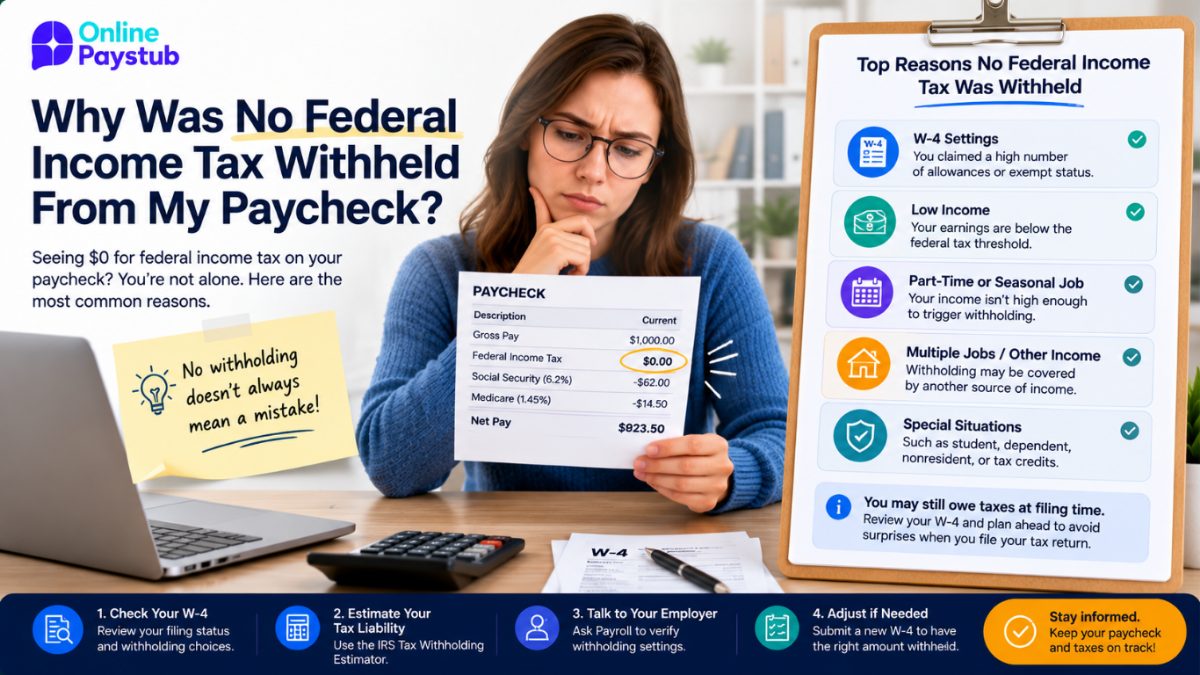
If no federal income tax was withheld from your paycheck, it does not automatically mean payroll made a mistake. Federal income tax withholding depends on your taxable wages, pay frequency and the information on your Form W-4. A low enough paycheck can result in $0 federal income tax withholding under the IRS tables.
Other explanations include claiming exemption from federal withholding, credits or deductions entered on Form W-4, or a payroll setup issue. Social Security and Medicare taxes are separate, so they can still appear even when the federal income tax line is zero.
Your Paycheck May Be Below the Withholding Level
The IRS withholding calculation uses wages for the payroll period together with Form W-4 information. Under the 2026 withholding tables, lower adjusted wage amounts can fall into a 0% portion of the calculation.
This can happen with part-time work, short workweeks or relatively low wages. It does not necessarily mean that the employee claimed a special exemption.
Your Form W-4 Can Reduce Withholding
Form W-4 tells an employer how to calculate federal income tax withholding. Filing status, multiple-job adjustments, credits, deductions and additional withholding can all affect the result.
An employee who entered qualifying credits or deductions may see less federal income tax withheld than another employee earning the same gross pay.
You May Have Claimed Exempt From Federal Withholding
For 2026, Form W-4 includes a checkbox for employees claiming exemption from federal income tax withholding. To qualify, an employee generally must have had no federal income tax liability in 2025 and expect no federal income tax liability in 2026.
Exempt status applies to federal income tax withholding, not automatically to Social Security, Medicare or state taxes. It is also not permanent. Employees who want to continue exempt status generally need to provide a new Form W-4 for the next year under IRS rules.
Federal Income Tax Is Not the Same as FICA
A paycheck can show $0 for federal income tax while still showing Social Security and Medicare deductions. These are separate federal taxes calculated under different rules.
IRS guidance states that employers are generally required to withhold Social Security and Medicare taxes from employee wages unless a specific exception applies.
Could Payroll Have the Wrong W-4 Information?
Yes. If your earnings seem high enough that you expected withholding, review the Form W-4 information your employer has on file. A data-entry issue or an old W-4 can produce a result you did not expect.
Ask payroll which W-4 is currently being used. If your situation has changed or the form no longer reflects your intended withholding, submit a new Form W-4.
What If You Never Submitted a Form W-4?
If a new employee does not provide a properly completed Form W-4, the employer generally must calculate federal income tax withholding as if the employee selected Single or Married filing separately with no entries in Steps 2, 3 or 4.
So simply failing to submit the form does not normally instruct an employer to withhold zero federal income tax.
Does No Withholding Mean You Will Owe Taxes?
Not necessarily. Whether you ultimately owe federal income tax depends on your total annual income, deductions, credits, filing status, other income and payments made during the year.
However, consistently having too little withheld can result in tax due when you file and may create an underpayment issue in some situations. A single paycheck is not enough to determine your final tax bill.
How to Fix Federal Income Tax Withholding
First, review your pay stub and confirm that the federal income tax line is actually zero. Then check your latest Form W-4 and consider your expected annual income and other jobs.
If you need to change withholding, submit a new Form W-4 to your employer. The IRS Tax Withholding Estimator can also help employees evaluate whether current withholding is likely to match their tax situation.
When to Ask Payroll for Help
Contact payroll if your W-4 information appears correct but the withholding still looks inconsistent with your wages, or if a deduction changed unexpectedly from one paycheck to the next.
Payroll can explain which form is on file and how the paycheck was processed. For personal tax planning beyond payroll processing, an IRS resource or qualified tax professional may be more appropriate.